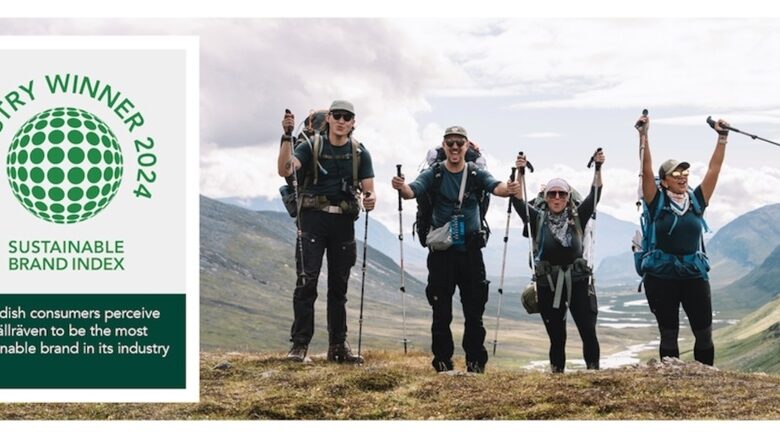
For the fifth year in a row, consumers in Sweden perceive Fjällräven to be the country’s most sustainable brand in the category, ‘Clothes and Fashion Brands’ in the 2024 Sustainable Brand Index.
With the help of 80,000 consumers across eight countries, the Sustainable Brand Index measures and analyses nearly 1,600 brands across 36 industries on consumer perception of sustainability. Carried out annually since 2011, the independent study examines how consumers perceive sustainable brands.
Founded in 1960, Fjällräven has built its global reputation on creating functional, durable and timeless products that are built to last for decades of use. “We’re extremely proud that Swedish consumers have once again recognised the efforts of the Fjällräven team,” said Martin Axelhed, Fjällräven CEO. “The journey isn’t always straightforward. Sustainability runs through every facet of the company and is constantly developing, whether it’s in the sourcing and traceability of materials or the elimination of forever chemicals. We’ve also recently recognised the need to communicate more directly with customers on our sustainability efforts, bringing them into the conversation and educating them on their own role in sustainability too, so we’re delighted that this work is having an impact.”
Fjällräven’s recent key focus has been on durability where educational content, in-store events and direct engagement with customers, through a recent and well-received CEO letter added to every product purchase, has highlighted the influence that users themselves can have on the lifecycle of a product. According to the company, care, repair, reuse and making gear usable long-term is key to generating one of the biggest environmental benefits. As the Sustainable Brand Index study suggests, being perceived as the most sustainable outdoor brand in Sweden is one thing, but leading the way in sustainability takes significant action – and over the years, Fjällräven has led the way in driving sustainability innovation and minimising its environmental impact. It has done this through its focus on:
Saying no to harmful chemicals
The Fjällräven Chemical Guidelines help the company navigate the complicated world of hazardous and banned chemicals, which it is constantly updating and revising based on new research. Read more about Fjällräven’s commitment to saying no to harmful chemicals like PFCs, here.
Saying no to animal mistreatment
The animal welfare, land use practices, and the economic viability of the farms Fjällräven sources from are crucial focus areas.
Saying no to resource-intense materials
Before Fjällräven decides on a material for a product, it evaluates its efficiency, functional qualities, chemical composition, and the amount of material needed. It also continuously works to improve the materials already in use. For example, its long-lasting G-1000 fabric is now being produced with considerably lower environmental impact than before.
Saying no to short-term trends
All Fjällräven products are designed to last for decades of use, to be passed on to the next generation, or sold on the second-hand market. That way, fewer products will be produced, less energy will be consumed and fewer products will end up as waste.
“Today, sustainability and CSR work is not just a ‘nice to have’, but essential for the long-term survival of a company,” said Aiko Bode, Chief Sustainability Officer at Fenix Outdoor. “They are both key strategic pillars at Fenix Outdoor and we’re very pleased this work is being recognised by Swedish consumers, who are known to place a very high value on sustainability standards. We will continue finding new solutions that stay in line with climate science, and hopefully even reach our own targets early.”
Fjällräven’s goal for 2025 is a 50 percent reduction in emissions per product produced, with sub-targets such as having 30 percent of its core suppliers use renewable energy. By 2050, the company is committed to reaching net zero.
Learn more about sustainability at Fjällräven here: https://www.fjallraven.com/eu/en-gb/about-fjallraven/sustainability